
An AI virtual influencer is a computer-generated character designed to look, act, and connect with audiences just like a real social media personality. In 2026, brands across the US are increasingly turning to these digital creators because they offer complete control, lower costs, and the ability to produce content at a scale that no human influencer could match.
What Is an AI Virtual Influencer?
An AI virtual influencer is a computer-generated persona, built with 3D modeling, CGI, and generative AI, that posts content, talks to followers, and promotes products on social media the same way a human creator would, except there’s no human behind the face. Think of it as a digital character with a name, a personality, a wardrobe, and an Instagram feed, except every photo, caption, and comment reply is produced by software instead of a person with a camera.
That’s the short answer. The longer story is more interesting, and it explains why this used to be a niche marketing gimmick and is now a real budget line item at companies you’ve heard of.
The category isn’t small anymore, either. The global virtual influencer market hit roughly $11.74 billion in 2026, according to SQ Magazine’s industry tracking, and it’s growing at a pace most marketing categories would kill for, somewhere north of 40% a year by most estimates. That kind of growth doesn’t happen because of novelty. It happens because brands are seeing results they can measure.
Why US Brands Are Rapidly Adopting AI Virtual Influencers
Adoption numbers tell the real story here. Brand adoption of virtual influencers climbed from 60% to 73% of surveyed companies worldwide in 2026, per a Gartner Emerging Marketing Technology survey covered by Amra and Elma and beauty and personal care brands are leading the charge at close to 90% adoption. That’s not experimental anymore. That’s mainstream.
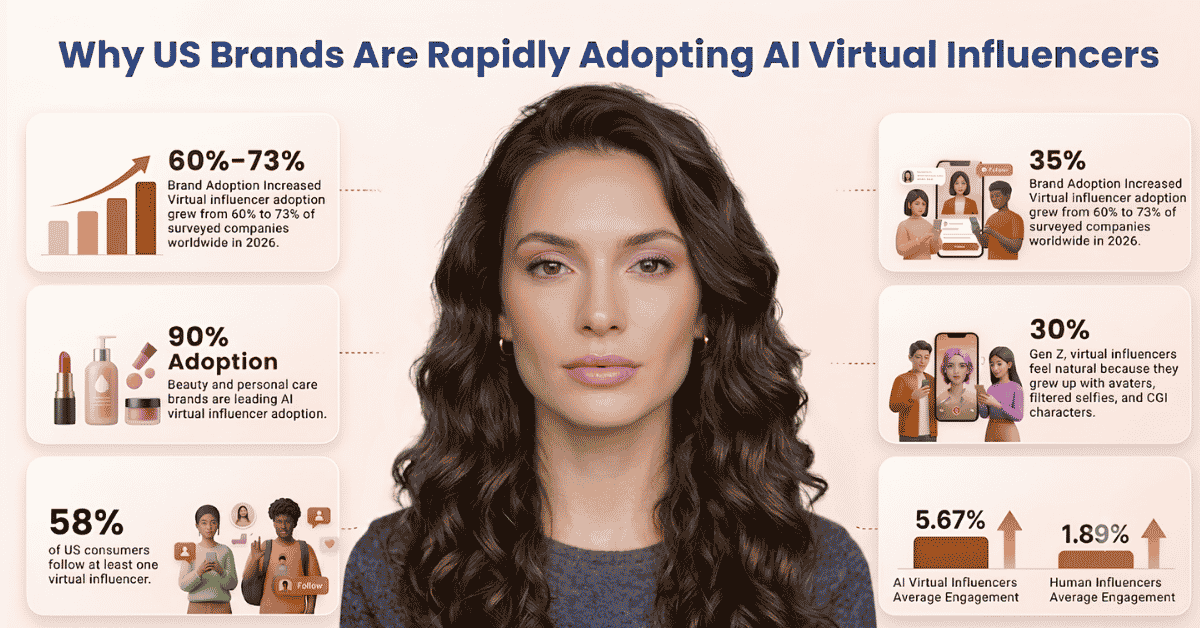
Part of it is generational. Fifty-eight percent of US consumers now follow at least one virtual influencer, and about 35% of Gen Z shoppers say they’ve bought something a virtual persona promoted, per AutoFaceless’s 2026 statistics roundup. Younger audiences simply don’t draw the same hard line between “real” and “digital” that older consumers do, they grew up with avatars, filtered selfies, and CGI characters, so a virtual influencer doesn’t feel like a trick. It feels normal.
Engagement backs this up too. Virtual influencer campaigns are pulling average engagement rates around 5.67%, compared to roughly 1.89% for human creators of similar size, according to HypeAuditor data cited by SQ Magazine. Whether that’s novelty, curiosity, or genuine connection, the numbers are hard to ignore when a CMO is deciding where next quarter’s budget goes.
Brand Safety and Full Creative Control for US Companies
Every marketing director has lived through this nightmare: you sign a creator, invest in a campaign, and three weeks later that creator says something in an unrelated interview that drags your brand name into a headline you never wanted. It happens more than most people admit.
A virtual influencer removes that risk almost entirely. There’s no personal life to go off-script, no old tweet to resurface, no scandal waiting to happen. The character only says what the brand approves. For companies that have been burned before, that alone can justify the investment.
Creative control goes further than just avoiding disasters, though. Brands own the intellectual property outright. There’s no negotiating with a talent agency over usage rights, no licensing renewal every year, no limits on how many campaigns the character can appear in. If a brand wants their influencer standing on the moon, on a beach in Bali, and in a boardroom, all in the same week, that’s just a production decision, not a logistics problem.
24/7 Availability and Major Cost Savings for American Brands
Human creators sleep, take vacations, and can only be in one place at a time. Virtual influencers don’t have that constraint. A single character can “appear” in a livestream in New York and a sponsored post targeting Tokyo in the same afternoon, without ever leaving a server.
The cost math is where things get genuinely compelling for marketing teams. Yes, building the initial 3D model and character design takes real investment, that upfront cost isn’t nothing. But once the character exists, producing new content is dramatically cheaper than booking a human creator, a studio, a stylist, and a location for every single shoot. There’s no travel budget, no day rate, no wardrobe rental. That’s a big part of why CMOs are reportedly planning to direct up to 30% of their influencer marketing budgets toward virtual personas, based on Ogilvy projections covered by AutoFaceless– a serious reallocation away from traditional creator deals.
For agencies managing multiple client accounts, this scalability matters even more. One well-built virtual character can support dozens of campaigns a year without the scheduling headaches that come with human talent.
Cross-Market Localization Benefits for US Businesses
A US brand trying to expand into Latin America, Southeast Asia, or the Middle East usually faces an expensive choice: hire local influencers in every market, or run one global campaign that doesn’t quite land anywhere.
Virtual influencers sidestep that problem. The same digital asset can be re-rendered to speak Spanish, Korean, or Arabic, adjust cultural references, and even shift stylistic choices to match regional taste, all without recasting or restarting a campaign from scratch. It’s the same underlying character wearing a different outfit, essentially.
This is part of why Asia-Pacific has become such a fast-growing region for virtual influencer spend, with China alone accounting for an estimated $1.6 billion tied to a follower base north of 340 million, according to Amra and Elma’s regional breakdown. American brands eyeing global growth are watching that number closely, because it shows virtual creators translate across borders in a way that’s hard for a single human spokesperson to replicate.
Popular AI Virtual Influencers US Brands Are Using Right Now
A handful of names come up constantly in this space, and each one shows a slightly different business model:
- Lil Miquela: one of the earliest and most recognizable virtual influencers, active since 2016. She’s partnered with Prada, Calvin Klein, and Samsung, and has generated an estimated $11 million in career brand-deal revenue.
- Lu do Magalu: the CGI mascot for Brazilian retailer Magazine Luiza, now earning close to what many top human creators make in a year, with roughly $2.5 million pulled in during 2024 alone across dozens of sponsored posts.
- Aitana Lopez: a Spanish AI model created by an agency specifically to work with fitness, gaming, and fashion brands, built from the ground up as a commercial product rather than a personal brand.
- Imma and Noonoouri: both popular in fashion and beauty campaigns, each with a distinct visual style that fits specific brand aesthetics.
What’s notable is how differently each one is monetized, some function like influencer-for-hire assets, others like a retailer’s permanent brand mascot. Brands are picking the model that fits their actual marketing goal, not just following a trend.
How to Create Your Own AI Virtual Influencer Step by Step
Brands considering their own character usually go through roughly the same process:
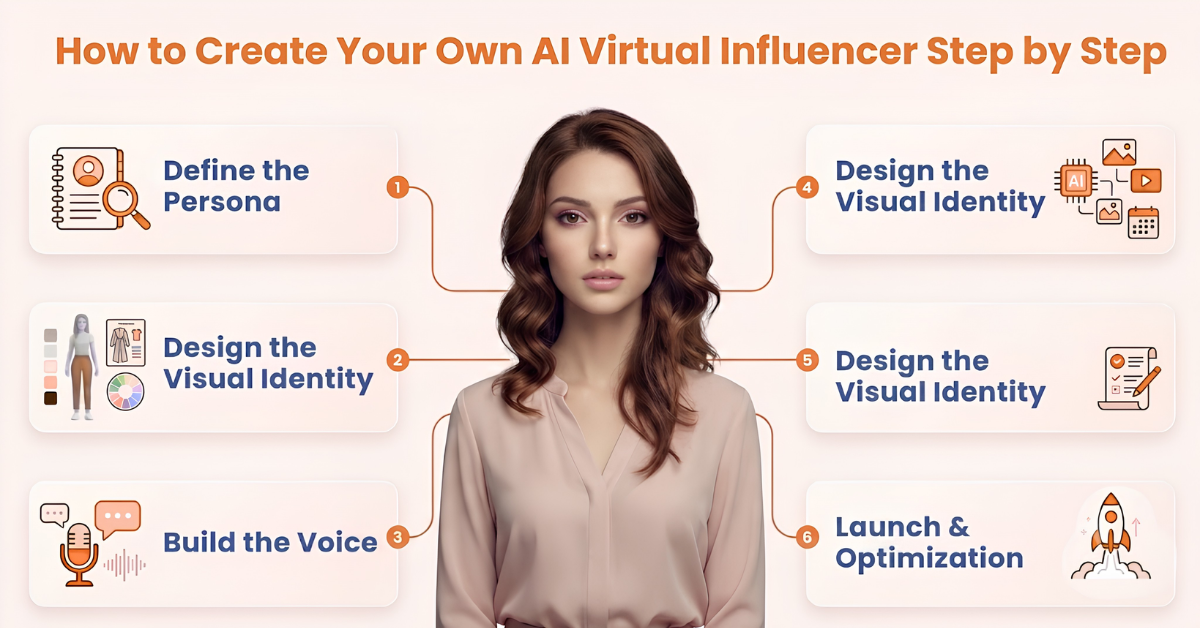
- Define the persona first: name, personality, backstory, values, and the audience the character is meant to speak to. Skip this and the influencer feels hollow no matter how good the visuals are.
- Design the visual identity: working with a 3D artist or an AI-image specialist to lock in a consistent face, body, and style guide the character will stick to across every post.
- Build the voice: deciding how the character writes captions, what tone it uses, and if video is part of the plan, choosing or training a voice model.
- Set up a content pipeline: a repeatable workflow for generating new posts, whether that’s AI image generation, video tools, or a hybrid of CGI and generative AI.
- Establish compliance guardrails: clear FTC-compliant AI disclosure on every post and platform-specific labeling (Meta and TikTok both require this now), plus a review process so nothing goes out unchecked.
- Launch and iterate: starting with a smaller content cadence, watching what resonates, and adjusting the persona based on real engagement data rather than guesswork.
Most brands underestimate step one and overinvest in step two. A stunning 3D model with no personality won’t hold an audience’s attention for long.
The Future of AI Virtual Influencers in American Marketing
The next phase of this industry looks less like “human creators versus virtual ones” and more like a blend of the two. Agencies are increasingly pairing photorealistic AI influencers with real creators, using the virtual character to go viral quickly and cheaply, then routing that attention toward salary-based human talent for deeper community engagement and fulfillment. It’s a hybrid model, and it’s picking up steam fast because it captures the reach benefits of AI without losing the authenticity that comes from an actual person.
Regulation is tightening too, and that’s worth planning around rather than ignoring. The FTC’s rule on fake and AI-generated endorsements has been in force since October 2024, and enforcement has only gotten more serious — civil penalties reached $53,088 per violation in 2025. Brands that treat disclosure as an afterthought are taking on real legal exposure, not just a reputational risk.
Where this heads next: more brands running multiple virtual personas across different regions and platforms, more sophisticated real-time interaction (virtual influencers that can respond live during a stream, not just post pre-made content), and closer integration with e-commerce, where the influencer isn’t just promoting a product but actively selling it inside the same app.
How Marketer Papa Helps US Brands Build AI Virtual Influencers
Marketer Papa works with American companies to develop custom AI virtual influencers that fit specific business needs. From strategy and character creation to content production and performance tracking, the team handles the technical side so brands can focus on results.
They emphasize brand-aligned personalities, measurable ROI, and ethical practices. Many clients appreciate the end-to-end support that turns the concept into active campaigns without internal headaches.
Conclusion
AI virtual influencers have moved well past the novelty stage. They’re a real line item in marketing budgets, backed by engagement numbers that outperform human creators on a per-post basis, and adopted by nearly three-quarters of brands surveyed worldwide. For US companies weighing the switch, the appeal comes down to a handful of practical wins: no PR surprises, full ownership of the creative asset, availability around the clock, and the ability to speak to a dozen markets without hiring a dozen different creators.
None of that means human creators are going away, if anything, the smartest brands are blending both. But if you’re building a 2026 marketing plan and haven’t at least evaluated what a virtual influencer could do for your brand, you’re already behind the 73% of companies that have.
Frequently Asked Questions
What is an AI virtual influencer?
An AI virtual influencer is a computer-generated digital character powered by AI, 3D modeling, and CGI that behaves like a real social media influencer. They post content, engage with followers, and promote brands, but they are entirely digital and fully controlled by their creators.
How do AI virtual influencers work in 2026?
In 2026, AI virtual influencers use generative AI for creating images and videos, natural language processing for writing captions and replying to comments, and real-time rendering for smooth animations. Human teams still guide strategy and approve content, but the technology handles most of the creative production.
Why are brands using AI virtual influencers in 2026?
Brands use them for full creative control, brand safety, 24/7 availability, and major cost savings. Unlike human influencers, virtual ones never cause scandals, can be updated instantly, and significantly reduce campaign costs after the initial setup.
Which brands are using AI virtual influencers right now?
In 2026, brands like Prada, Calvin Klein, Samsung, Nike, Coach, and IKEA have worked with virtual influencers such as Lil Miquela, Imma, and Shudu Gram. Many US retailers and fashion companies are also building their own private virtual ambassadors.
How do AI virtual influencers make money?
AI virtual influencers generate revenue mainly through brand sponsorships and paid partnerships, the same way human influencers do. Some, like Lu do Magalu, function as a retailer’s owned brand mascot, while others operate as independent commercial assets licensed out across multiple campaigns and industries.
What is the future of AI virtual influencers in marketing?
By 2030, the virtual influencer market is expected to reach $45 billion+. The future is hybrid, brands will use both human and virtual influencers. Expect more advanced real-time interactions, AR integration, and personalized experiences for audiences.