
What Does a Podcast Editor Do? A Complete Beginner's Guide (Should You Hire One?)
Podcast editing is the process of turning raw recordings into a clean, consistent, and engaging episode ready for publishing. This guide explains what a podcast editor actually does, how editing differs from full production, the tools editors use, whether video is included, typical costs, and how to decide between DIY and hiring a pro plus what to look for in an agency and what to do once your episodes are edited.
What Does a Podcast Editor Actually Do?
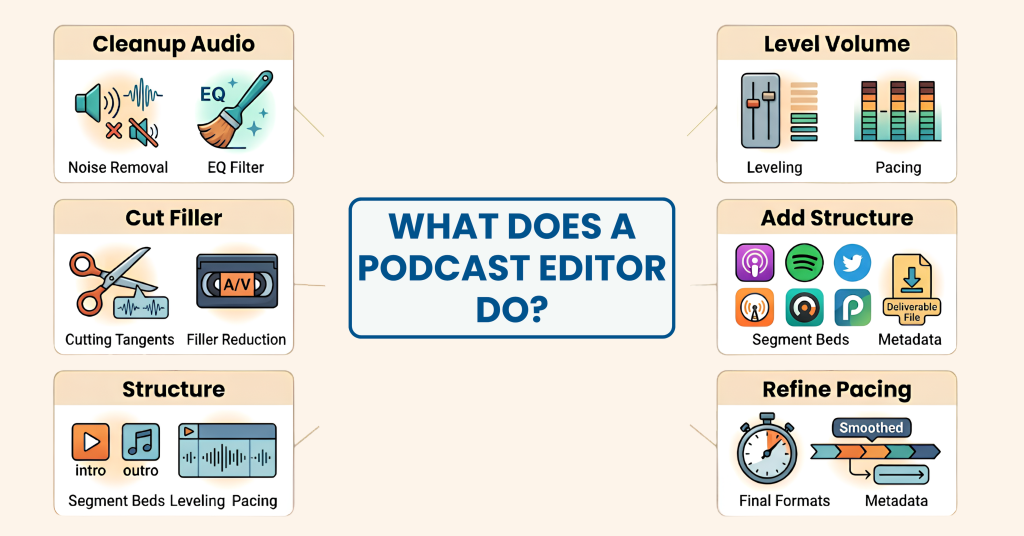
A podcast editor’s core job is audio (and often video) post‑production: taking your recorded tracks and making them sound professional and easy to listen to. Day to day, that means:
A podcast editor’s core job is audio (and often video) post‑production: taking your recorded tracks and making them sound professional and easy to listen to. Day to day, that means:
- Cleaning up raw audio: removing background noise, clicks, plosives, and echo; applying EQ, compression, and de‑essing for clarity.
- Cutting mistakes and filler: trimming false starts, long pauses, tangents, and excessive “um/uh” to tighten pacing without sounding choppy.
- Leveling volume: balancing levels between hosts and guests so no one is too loud or quiet, then normalizing loudness to platform standards.
- Adding music and structure: inserting intros, outros, segment beds, sponsor reads, transitions, and sometimes sound effects or chapter markers.
- Exporting deliverables: rendering final files in the right format and specs for Apple Podcasts, Spotify, YouTube, and your host platform; sometimes generating show notes or timestamps.
In short, a podcast editor handles the technical and editorial cleanup that turns a rough conversation into a polished episode.
Podcast Editing vs. Podcast Production: What’s the Difference?
Editing is one part of a larger workflow; production covers the whole show lifecycle.
Aspect | Podcast Editing | Podcast Production |
Scope | Post‑production cleanup and assembly of recorded files | End‑to‑end: planning, recording, editing, publishing, and promotion |
Typical tasks | Noise reduction, cutting, leveling, mixing, adding intro/outro, exporting | Concept/format design, guest booking, recording management, editing, show notes, distribution, analytics, growth strategy |
Outcome | A clean, publish‑ready episode file | A consistently executed show that grows over time |
Editing gives you a clean file; production gives you a partner who helps shape the show’s direction and handles operations beyond the edit.
What Tools and Software Do Podcast Editors Use?
Editors choose tools based on budget, workflow, and whether they need AI assistance or pro-level control. Common options include:
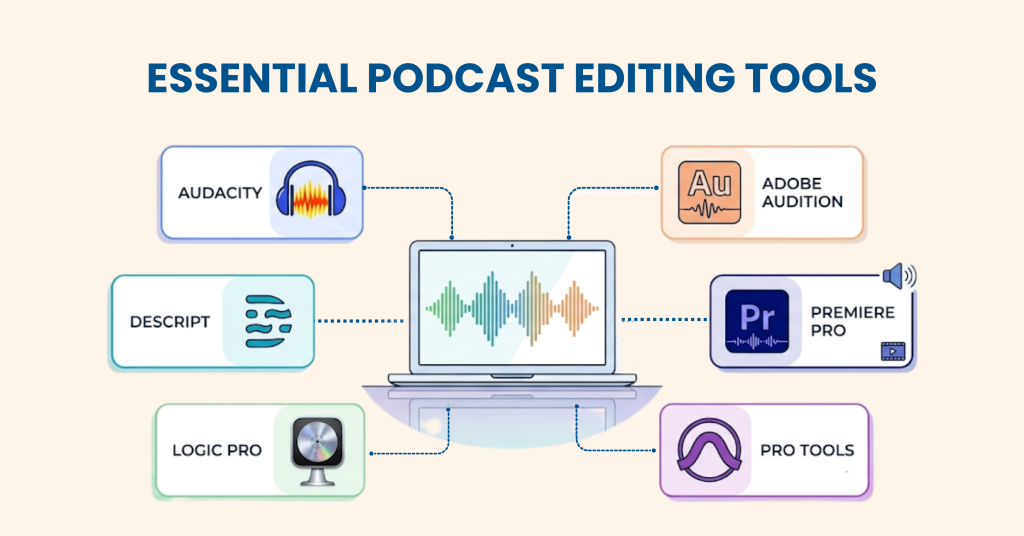
- Audacity: Free, open‑source DAW for cutting, noise reduction, EQ, and basic mastering; great for DIY editors on a budget.
- Adobe Podcast (and Adobe Audition): Cloud tools for AI noise removal and enhancement, plus professional DAW features for detailed mixing and mastering.
- Adobe Premiere Pro: Professional video editing software for creating, editing, and polishing video podcasts; supports multitrack editing, audio mixing, effects, and seamless video production.
- Descript: Popular for transcript‑based editing delete words in the transcript and the audio cuts automatically; also supports multitrack, video, and AI cleanup.
- Other pro DAWs: Hindenburg, Logic Pro, Reaper, and Pro Tools are widely used for advanced mixing, automation, and sound design.
Many editors combine tools for example, using Adobe Podcast or Descript’s AI to clean dialogue, then finishing in a DAW for precise leveling and music beds.
Does Podcast Editing Include Video?
Increasingly, yes. Video podcasts have grown significantly, and many editors now offer combined audio + video packages. Video podcast editing typically includes:
- Syncing multi‑camera angles and screen shares to the audio timeline.
- Color correction, basic graphics (lower thirds, titles), and chapter markers.
- Exporting platform‑specific versions (e.g., horizontal for YouTube, vertical clips for Shorts/Reels/TikTok).
If you plan to publish on YouTube or repurpose clips, confirm that your editor or agency handles video podcast editing and deliverables.
How Much Does Podcast Editing Cost?
Pricing varies by scope, episode length, number of tracks, and whether video is included. Typical ranges in 2025–2026:
- Basic audio cleanup: around $50–$100 per episode for straightforward cuts, noise reduction, and leveling.
- Full audio production: $70–$100+ per episode when it includes detailed editing, mixing, mastering, intro/outro, and sometimes show notes.
- Audio + video packages: $200+ per episode for multi‑cam editing, graphics, and platform exports.
At Marketer Papa, we offer competitive podcast editing packages designed to deliver professional quality without the high cost of traditional production services.
Should You Hire a Podcast Editing Service or Do It Yourself?
Choose based on your time, quality goals, and budget.
DIY makes sense if:
- You’re testing the show or have a very tight budget.
- You enjoy learning audio tools and can commit 1–3 hours per episode.
- Your format is simple (single host, minimal guests).
Hiring a professional podcast editing service or agency makes sense if:
- You value consistent, broadcast‑ready quality and want to save time.
- You have multiple speakers, remote recordings, or video to manage.
- You want reliable turnaround and a repeatable workflow as your show grows.
In practice, many creators start DIY, then outsource once the show gains traction or their schedule fills up.
What to Look for in a Podcast Editing Agency
Use this checklist when evaluating a top podcast production agency or editing partner:
- Turnaround time: Clear SLA (e.g., 24–72 hours per episode) and on‑time delivery track record.
- Revision policy: How many rounds of edits are included and what changes count as revisions.
- Experience with your format: Interview shows, panel discussions, narrative storytelling, or corporate podcasts each need different editing approaches.
- Audio + video capability: Ability to handle multi‑track audio, remote recordings, and video podcast editing if you publish on YouTube or social.
- Deliverables and specs: Final files matched to your host and platforms (loudness standards, codecs, captions/chapters if needed).[
- Communication and workflow: Simple file handoff (Drive/Dropbox), project tracking, and a single point of contact.
How to Launch Your Podcast After Editing Is Done
Once episodes are edited, focus on publishing and promotion:
- Hosting and RSS: Upload to a podcast host, verify the RSS feed, and submit to Apple Podcasts, Spotify, and other directories.
- Metadata and assets: Write compelling titles/descriptions, add cover art, and include chapter markers or show notes where supported.
- Launch plan: Drop 2–3 episodes on day one, schedule future releases, and prepare social posts, email announcements, and trailer clips.
- Repurposing: Turn edited episodes into short video clips, audiograms, and blog posts to drive discovery.
If you want extra lift, a podcast launch service or audio editing services partner can handle distribution checks, trailer creation, and initial promotion.
Need a Custom Podcast Editing Plan?
Every podcast has different needs. If you need more than 4 episodes per month, prefer one-time editing instead of a subscription, or need premium services, we can create a plan that fits your show.
Looking for a custom solution? Contact our team today, and we’ll build a podcast editing package based on your needs.
- Need more than 4 episodes per month?
- Prefer one-time credits instead of a subscription?
- Need premium services instead of basic editing?
- Have a custom project in mind?
Conclusion
A skilled editor turns raw recordings into a polished, professional show by cleaning audio, cutting mistakes, balancing levels, and adding music and structure. Whether you DIY or hire a professional podcast editing service, consistency and quality are what keep listeners coming back.
Frequently Asked Questions
What does a podcast editor actually do day to day?
They clean up raw audio, remove mistakes and filler words, balance volume between speakers, and add intros, outros, and music before the episode is published.
How much does professional podcast editing cost?
Pricing varies widely from around $50–$100 per episode for basic cleanup to70$–$100+ for full production including video editing.
Is it worth hiring a podcast editing service instead of doing it myself?
If you value your time and want consistent, professional‑quality episodes, hiring a service is often worth it, especially once your show grows.
Do podcast editors also handle video podcasts?
Many do video podcast editing, which has grown significantly, and many editing services now offer combined audio and video packages.
What other podcast services can I get?
You can also get short video clips, transcripts, show notes, podcast graphics, and social media content to help you share and promote your podcast.
What should I look for in a podcast editing agency?
Look for fast turnaround time, clear revision policies, experience with your podcast format, and the ability to handle both audio and video if needed.