
If your website traffic dropped suddenly in 2026, the most likely causes are AI-powered search overviews reducing clicks, Google’s March 2026 core update reshuffling rankings, content that hasn’t kept pace with search intent, or technical issues that quietly pushed your pages down.
The good news: most of these drops are fixable. But only if you diagnose the right cause first and respond in the right order.
Why Your Website Traffic Dropped in 2026
Traffic drops in 2026 feel different from what SEOs dealt with even two years ago. The search results page has changed dramatically. AI summaries now sit above the blue links. Users are splitting their searches across Google, YouTube, Reddit, ChatGPT, and TikTok. And Google’s algorithm is now more aggressive at rewarding genuine expertise and penalizing content that exists primarily for rankings.
According to research from DigitalApplied, Google’s March 2026 core update affected more than 55% of monitored domains, with sites experiencing traffic drops of 20–35% and some reporting losses exceeding 50% on their most affected pages.
Before you fix anything, you need to know what actually happened. The recovery path for an algorithm hit looks completely different from the recovery path for a technical issue or a tracking error.
AI Search Overviews Are Stealing Your Clicks
This is the single biggest shift in how Google works in 2026 and it’s caught a lot of website owners off guard.
Google’s AI Overviews now answer questions directly on the search results page. Instead of showing users ten blue links and letting them click through, Google summarizes the answer, pulls from multiple sources, and presents it before anyone clicks anything. These are called zero-click searches.
According to HigherVisibility, some websites have lost 20–40% of their organic traffic since AI Overviews became widespread and certain news and informational sites saw CTR drops as high as 56%.
Here’s the part that catches people off guard: your rankings may not have changed at all. You might still be ranking #1 for a keyword. But if Google’s AI Overview is summarizing the answer above your result, fewer people need to click through to your site. Your impressions stay the same or even increase but your clicks fall.
If you open Google Search Console and see stable impressions with declining CTR, this is your likely cause.
Google Algorithm Updates Shifted Your Rankings
The March 2026 core update was one of the most significant ranking reshuffles in recent memory. It continued the direction Google has been moving since the Helpful Content era, rewarding content with genuine expertise, first-hand experience, and real information value over content that technically answers a query but offers nothing beyond what’s already out there.
What the update specifically targeted:
- High-volume AI-generated content with minimal editorial oversight
- Author expertise signals that were surface-level, bio pages without verifiable credentials or external profiles
- Thin pages that answered queries without adding new perspective, data, or depth
- Sites with a high ratio of low-quality to high-quality content, which compressed rankings site-wide
Content Decay: Why Old Pages Are Losing Ground
Content decay is the slow, often invisible process by which pages lose their relevance and rankings over time. When it happens:
- The page’s information is old (for example, statistics from 2022, tools that are no longer available, or processes that have changed).
- Competitors write about the same things in more depth and with more recent information.
- People’s search intent changes with a keyword; now they want a tool, a comparison, or a quick answer instead of a long explanation.
- There are no signs that the page has been updated in the last 90 days.
In 2026, content that hasn’t been updated or that doesn’t match what people are looking for now is losing ground quickly. Google’s system for helpful content doesn’t just look at pages on their own. It looks at how much value a website adds as a whole. A site with 40% old or low-quality content often has even its best pages dragged down.
Technical Issues That Quietly Kill Your Traffic
Not all traffic drops come from algorithm changes or AI. Sometimes the cause is something technical that nobody noticed until it was already causing damage.
These are the most common technical problems quietly hurting websites in 2026:
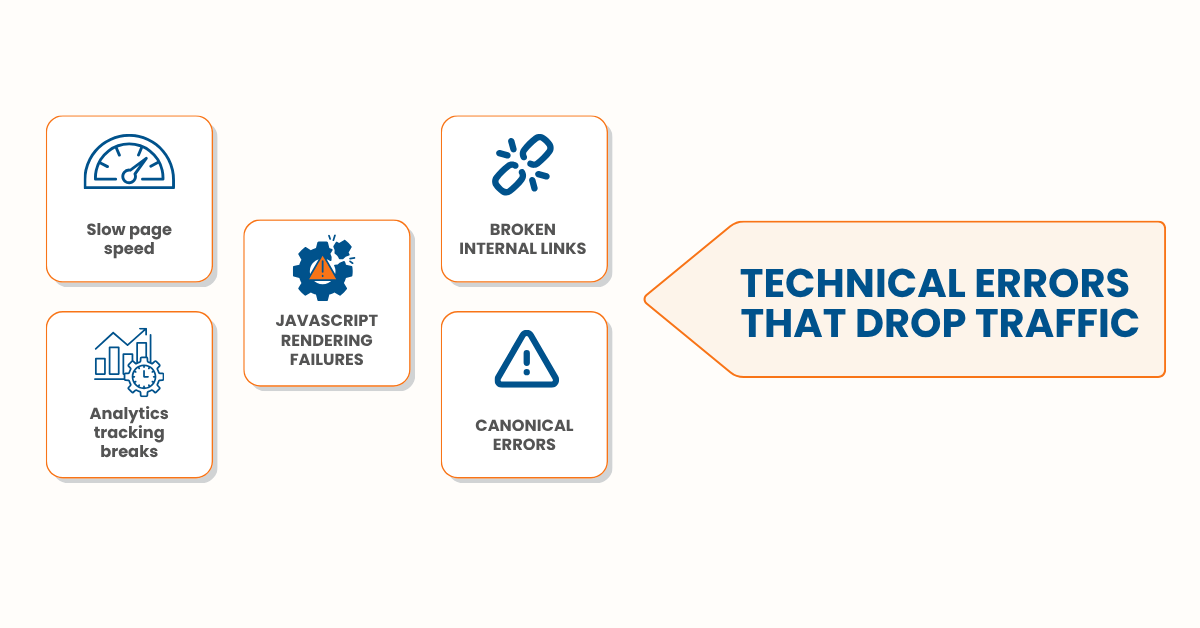
- Slow page speed: mobile users get hit the hardest here. Google’s Core Web Vitals benchmarks are stricter on mobile, and a slow-loading page loses rankings fast.
- Broken internal links: when links inside your site point to pages that no longer exist, those pages become orphaned. Google can’t find them, so they stop showing up in search.
- JavaScript rendering failures: if your site loads content dynamically through JavaScript, search engines may never actually see that content. It exists for users but stays invisible to Google’s crawler.
- Canonical errors: a small mistake in your canonical tags can send Google to the wrong version of a page. When that happens, the right page loses ranking power it should be keeping.
- Analytics tracking breaks: a CMS update, a new plugin, or a consent banner change can quietly break your GA4 setup. Your actual traffic stays the same but your reports show a sharp drop, which looks like a crisis when it isn’t one.
A quick diagnostic: compare your Google Search Console impressions against your GA4 sessions for the same period. If impressions are stable but sessions dropped sharply, your tracking is likely broken, not your traffic.
Users Are Moving to AI Tools and Other Platforms
Search behavior in 2026 is fragmented in a way it’s never been before. Users aren’t just going to Google for answers. They’re asking ChatGPT, searching Reddit, watching YouTube explainers, scrolling TikTok, and using Google Lens.
According to Viacon’s 2026 analysis, roughly 1 in 10 searches now starts with Google Lens rather than a text query. Meanwhile, AI assistants are handling research that used to require visiting 3–5 websites. Users get the summary, skip the source.
This isn’t going away. The businesses recovering best right now are the ones building visibility across multiple channels, not just waiting for Google to send traffic back.
How to Recover Lost Website Traffic in 2026
To recover lost website traffic in 2026, you need to first diagnose the exact cause, whether it’s an algorithm update, AI Overview impact, technical issue, or content decay. then fix it in the right order. Rushing into changes without knowing the root cause wastes time and can make things worse. Most sites that recover do so within 4–12 weeks after making the right structural improvements.
Here are the 6 steps to get your traffic back:
Step 1: Diagnose Your Traffic Drop the Right Way
Before you change anything on your site, spend time on your data. Most people skip this step and waste weeks fixing the wrong problem.
Open Google Search Console first:
- Go to Performance,compare the last 28 days to the same period last year
- Break down by page, query, device, and country
- Look for three distinct patterns:
What you see | What it means |
Impressions down + clicks down | Discoverability issue — rankings dropped |
Impressions stable + clicks down | Zero-click / AI Overview impact |
Impressions up + clicks down | SERP features absorbing the demand |
All channels down together | Tracking failure or site-wide technical issue |
Once you know which pattern you’re dealing with, your recovery strategy becomes clear. Trying to fix rankings when the problem is actually tracking is a waste of time and the reverse is equally true.
Step 2: Optimize Your Content for AI Search (AEO)
Answer Engine Optimization (AEO) is the 2026 version of featured snippet optimization, except the stakes are higher. Instead of winning a box on the search results page, you’re trying to become the source Google’s AI Overview pulls from.
How to do this effectively:
- Answer the question in the first 2–3 sentences of every section, before any background or context.
- Use clear, question-based H2s and H3s that match how people actually phrase their searches.
- Add structured FAQ sections at the bottom of key pages with direct, concise answers.
- Use FAQ schema and HowTo schema to signal to Google exactly what your content answers.
- Write for the snippet, not the page, keep answers short and standalone so they make sense without reading the whole article.
According to HigherVisibility, optimizing long-tail Q&A sections where AI can summarize your content in its response is one of the most effective ways to maintain visibility even as zero-click searches increase.
Step 3: Build Stronger E-E-A-T Signals on Your Site
Google’s March 2026 update made one thing very clear: expertise signals that worked in 2024 are no longer sufficient. Vague author bios and generic “about us” pages don’t cut it anymore.
What Google is thinking about right now:
- Authors with real profiles on LinkedIn, in industry magazines, and on pages for speakers at conferences.
- Cited sources are specific pieces of information that can be traced back to the original research, not just general statements.
- First-hand experience: writing that shows the author has actually done the thing they’re writing about, not just repeated what others have said.
- Original research and data: surveys, case studies, or analyses that you can’t find anywhere else.
Practically, this means going through your highest-traffic pages and adding real author credentials, updating outdated statistics with current sources, and adding perspective that only comes from genuine experience in the topic.
Step 4: Consolidate Weak Pages Before They Hurt You
A lot of site owners are surprised to learn that deleting low-quality pages can actually help the pages you keep rank higher.
Google checks the quality of a whole domain, not just one page. Even the best content on a site with 200 thin, old, or unnecessary pages will have that ratio work against it. This pattern was clearer than ever after the March 2026 update.
- How to go about consolidation:
- Find content that overlaps, like several pages that answer the same question or target the same keyword.
- 301 redirects can send weak pages to stronger ones.
- Instead of keeping pages that are really low-quality live, take them down with a 410 Gone status.
- Combine short posts into long, well-researched guides.
Use Google Search Console to find pages with the highest impression-to-click ratios, those are pages Google is showing but users aren’t choosing. That’s your consolidation list.
Step 5: Fix Technical SEO Regressions Immediately
If your diagnosis points to a technical cause, speed matters. Technical issues compound over time, broken crawl paths mean pages stop being indexed, which means rankings disappear even when the content is good.
Run a full site audit using Screaming Frog or a similar crawler. Focus on:
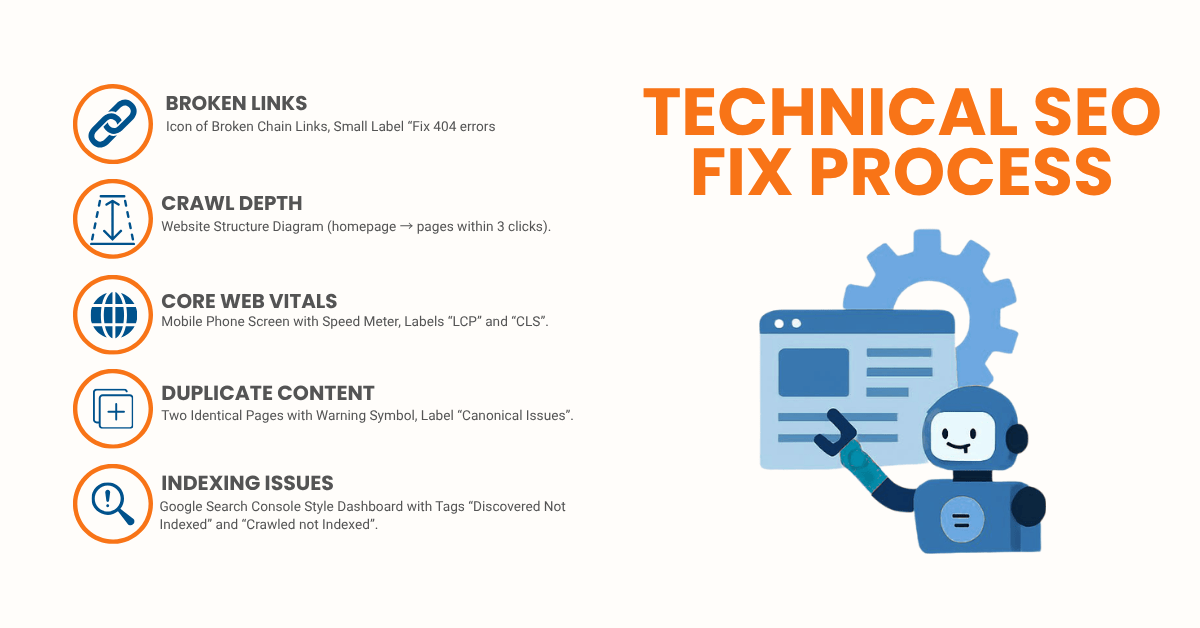
- Broken internal links: fix every 404 error or send it to a page that works.
- Crawl depth: make sure that you can get to important pages from your homepage in three clicks.
- Core Web Vitals: On mobile, pay special attention to Largest Contentful Paint (LCP) and Cumulative Layout Shift (CLS).
- Duplicate content: look for canonical tag mistakes that might be lowering the authority of your page.
- Check Google Search Console for pages that say “Discovered but not indexed” or “Crawled but not indexed” to see if they are indexed.
Technical fixes typically show movement in 2–4 weeks once Google recrawls the affected pages. Content improvements take longer, expect 4–8 weeks minimum before you see meaningful ranking changes.
Step 6: Diversify Traffic Beyond Google Search
If the last few months have taught us anything, it’s that relying on Google as your only source of traffic is a big risk for your business. The sites that recover the fastest in 2026 aren’t just getting Google back; they’re also making traffic channels that don’t rely on it.
Channels worth investing in now:
- Email marketing: the one channel where your relationship with your audience doesn’t depend on an algorithm. Businesses earn an average of $42 for every $1 spent on email marketing (Marketing Insider Group)
- YouTube content: video answers are showing up directly in AI search results. Being on YouTube means being in that ecosystem
- Reddit and community presence: Google is actively surfacing Reddit content in results. Being a genuine contributor to relevant communities builds both visibility and trust
- Social search: TikTok, Instagram, and Pinterest are functioning as search engines for significant portions of the population, particularly under 35
None of these replace SEO. But they reduce your exposure when Google changes the rules again and it will.
Conclusion
A sudden traffic drop in 2026 is stressful, but it’s not permanent. The sites that come back stronger are the ones that take the time to diagnose the real cause, make genuine quality improvements, and stop relying on a single traffic source.
If your impressions are stable but clicks are falling, you’re dealing with AI Overview impact, adjust your content structure for AEO. If rankings dropped after March 2026, focus on E-E-A-T and consolidating weak content. If all channels dropped at once, check your tracking before you do anything else.
The path forward is clear. It just requires doing the work properly rather than looking for shortcuts that Google’s current systems are better at detecting than ever before.
Frequently Asked Questions
Why did my website traffic drop suddenly in 2026?
When traffic drops suddenly in 2026, it’s usually because Google’s AI Overviews show answers right on the search page, the core algorithm was updated in March 2026, content that is no longer relevant, or a technical problem on your site. Before making any changes, check Google Search Console to see which pages and channels were affected.
What are AI Overviews and why are they reducing my website clicks?
Google’s AI-generated summaries, called AI Overviews, show up at the top of search results and answer questions directly before users click on any links. Your page could be the first result, but the AI summary above answers the question, so people never go to your site. This is known as a “zero-click search,” and it’s one of the main reasons why traffic fell in 2026, even for pages that were doing well.
What is content decay and how does it affect my website traffic?
Content decay happens when pages gradually lose rankings because the information becomes outdated, competitors publish fresher content, or search intent around keyword shifts. In 2026, pages that haven’t been updated in 90 days or more and no longer match what users are actually looking for lose ground quickly. Regularly refreshing your top pages with current data and updated perspectives is one of the most effective ways to prevent it.
How do I optimize my content for AI search in 2026?
To improve AI search, answer the main question in the first two or three sentences of each section before giving any background or context. Use headings that are based on the questions people really ask. Put FAQ sections with short, direct answers at the bottom of important pages. Use FAQ schema and HowTo schema markup to let Google know what your content answers.
How do I optimize my content for AI search in 2026?
To make AI search work better, answer the main question in the first two or three sentences of each section before giving any background or context. Use headings that are based on questions that people actually ask. At the bottom of important pages, add FAQ sections with short, direct answers. Use FAQ schema and HowTo schema markup to make it clear to Google what your content answers.