
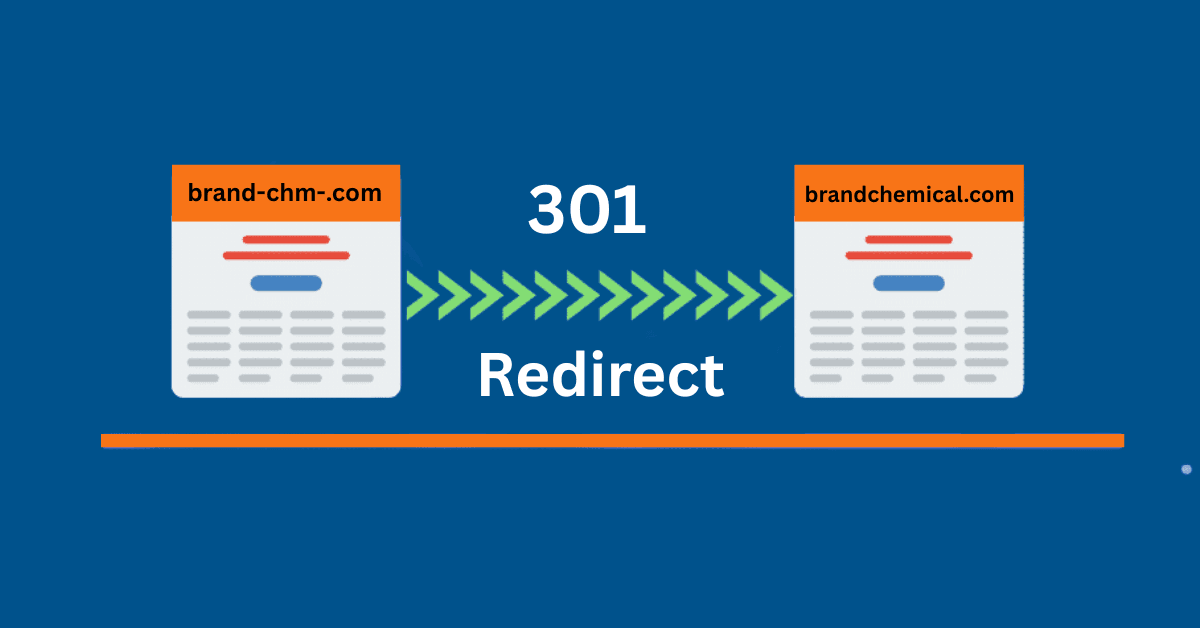
Let’s explore how a leading chemical company faced significant challenges after purchasing a new domain for branding purposes. Their goal was to switch the existing domain to the newly purchased one and redirect traffic from the old domain to the new one without negatively impacting the indexed pages. This transition led to the new domain being introduced to the existing URL structure. And the challenge was to maintain the existing ranking for relevant industry keywords.
For client privacy, we’ve used “brandchemical.com” as a placeholder and not the actual domain.
The client began with a modest product line featuring a basic hydrochloric acid bowl cleaner and a mechanics-type hand cleaner. Over time, they have expanded into a privately held company with over 70 employees, offering more than 800 products. Their diverse range serves industries across the United States, Canada, Mexico, and Puerto Rico. The company’s commitment to innovation is evident in their continuous development of cutting-edge formulations, including environment friendly solutions for automatic, conveyor, and self-service car washes. Their mission is to deliver reliable, high-quality chemical solutions that meet the evolving needs of their customers.
Previously, the client owned the domain name brand-chm.com. However, they have purchased brandchemical.com, to enhance their brand presence. They planned to redirect all URLs from the old domain to the new one so visitors and search engines could easily find their new domain. However, the switch caused unexpected problems that led to a temporary drop in traffic and rankings.
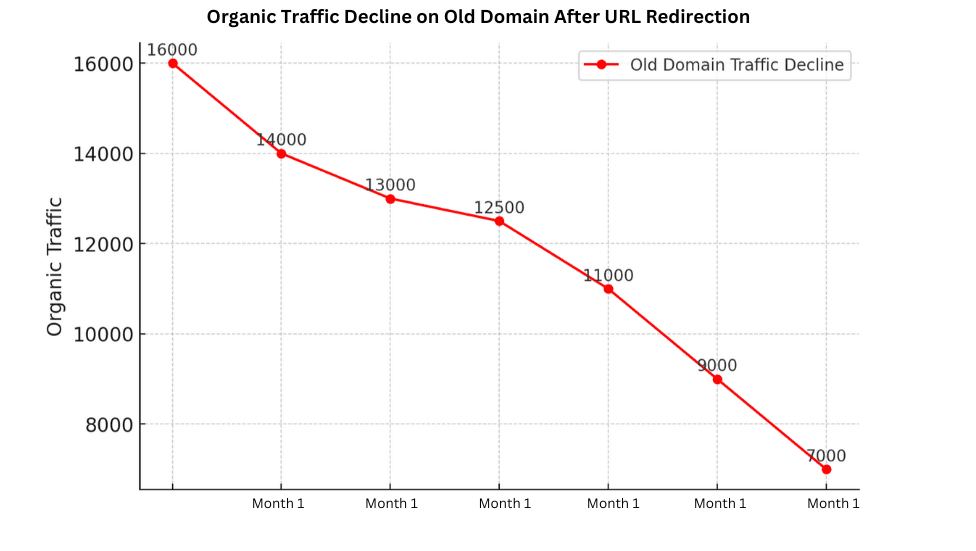
Because of these delays, traffic on the old domain dropped fast, while the new domain was still gaining strength. This created a temporary dip in visitors and search rankings.
To fix this, we implemented a structured URL redirection strategy to ensure search engines and users were guided to the correct pages without losing authority.
We set up 301 redirects for all URLs, ensuring that 122 pages seamlessly direct visitors and search engines to the correct pages on the new domain. This helped search engines transfer ranking signals from the old domain to the new one, allowing traffic to gradually shift and grow. We also updated sitemaps and indexing settings to speed up Google’s recognition of the new URLs.
At the same time, we optimized the new domain URL structures with relevant keywords. Also we improved on-page SEO, cross-checked and strengthened internal linking to enhance crawlability. This strategy helped the new domain gain traction.
During this time, traffic was diverted to brandchemical.com from brandchm.com as the original domain was redirected to the new one. As a result, traffic to the old domain declined.
Additionally, new domain traffic started increasing for the same reason. However, we have encountered a few ranking issues in the new domain.
To solve that, we checked the website structure and fixed missing 301 redirects so that all old links pointed to the right new ones. This helped search engines find and index pages correctly. We also updated the sitemap and robots.txt file to speed up the reindexing process.
Next, we optimized keywords by studying which rankings were lost and mapping the right search terms to each page. We improved title tags, meta descriptions, and internal links so search engines could better understand the content.
To reduce bounce rates, we improved site navigation so users could easily find what they needed. Fixing broken links and improving page speed helped keep visitors on the site longer.
We also worked on boosting conversions by making landing pages clearer and calls-to-action (CTAs) more effective. This helped increase the conversion rate by 50%, showing that better user experience leads to more sales.
The final step was to monitor SEO performance weekly, tweaking the strategy based on search trends. Within a few months, rankings improved, top 10 keywords increased by 140%, and traffic recovered to 18,000 visits, restoring the company’s online presence.
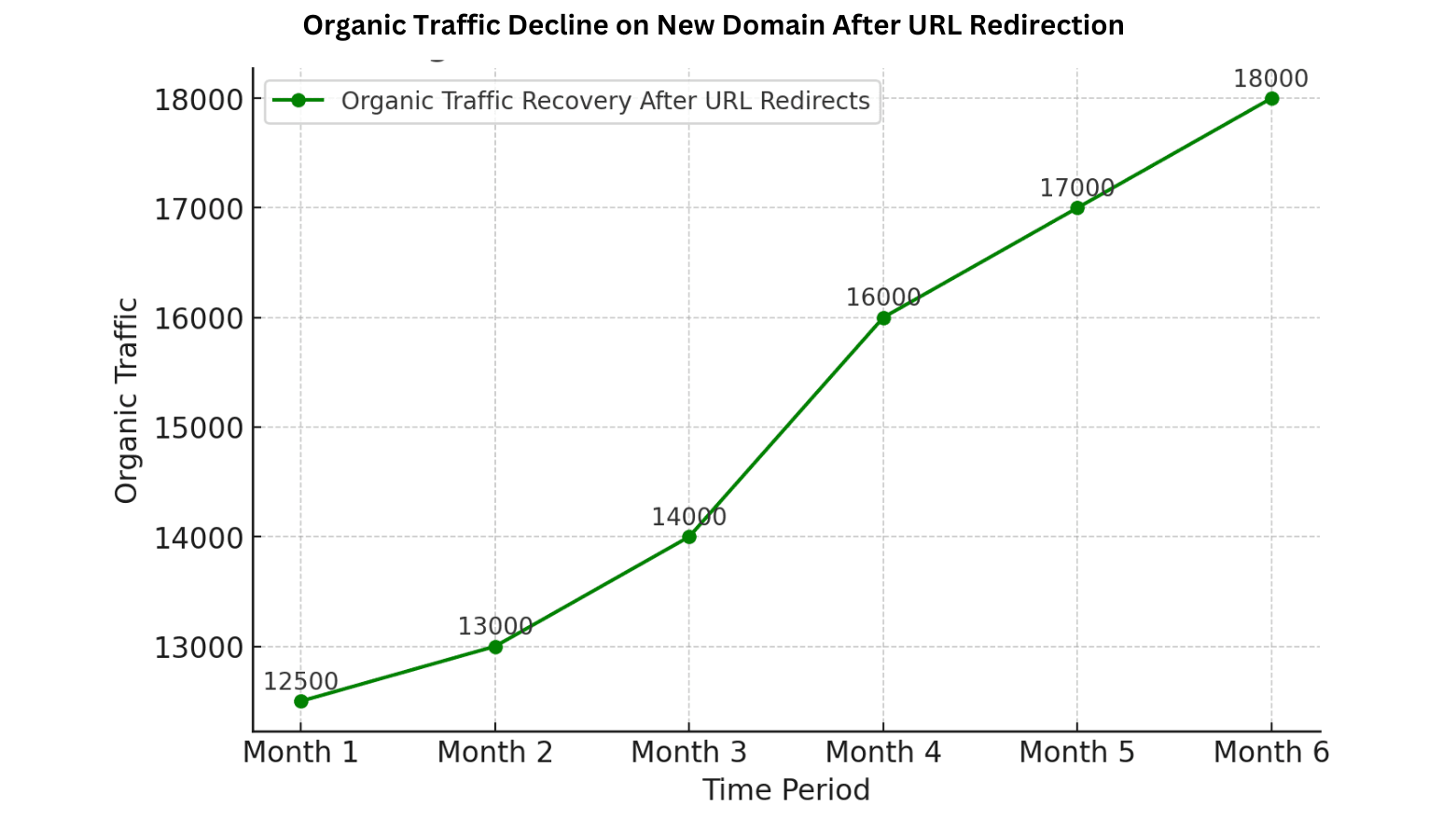
After implementing SEO-friendly URLs and 301 redirects, the client saw a 44% traffic recovery, improved rankings, and better user engagement. The bounce rate dropped to 58% (monthly), and conversions increased by 50%, proving the impact of strong SEO fixes on search visibility and growth.
| Metric | Before | After Redirection (Decline) | After Redirection (Recovery) | Change (Decline %) | Change (Recovery %) |
|---|---|---|---|---|---|
| Organic Traffic | 16000 | 12500 | 18000 | -21.88% | +44% |
| Avg. Keyword Rank | 25 | 37 | 30 | +48% | -18.92% |
| Bounce Rate (%) | 38 | 45 | 32 | +18.42% | -28.89% |
| Conversion Rate (%) | 3 | 1.8 | 3.6 | -40% | +100% |
| Top 10 Ranked Keywords | 16 | 5 | 12 | -68.75% | +140% |
The domain redirection initially led to a 21.88% decline in organic traffic, dropping from 16,000 to 12,500 visits within the first three months. This decrease was largely due to SEO misconfigurations, lack of proper redirects, and loss of authority on search engines. However, after implementing corrective SEO measures, traffic rebounded by 44%, reaching 18,000 visits in the following three months.
Keyword rankings suffered a 48% drop, with the average keyword position worsening from 25 to 37. This decline directly impacted search visibility and resulted in lower impressions and clicks. As part of the recovery strategy, targeted keyword optimization and proper URL restructuring helped improve rankings to 30, restoring the client’s competitive position.
User engagement metrics reflected the negative impact of the SEO missteps. Bounce rate increased from 38% to 45%, indicating that users were either landing on irrelevant pages or experiencing poor navigation due to improper domain handling. With improved site structuring and enhanced internal linking, the bounce rate decreased to 32%, signaling improved user experience and content relevance.
The conversion rate declined by 40%, falling from 3.0% to 1.8%, as a direct consequence of reduced organic traffic and lower-quality sessions. Once ranking recovery efforts were in place, the conversion rate improved by 100%, reaching 3.6%, demonstrating the effectiveness of a structured SEO strategy in attracting high-intent visitors.
The number of top 10 ranked keywords plummeted by 68.75%, dropping from 16 to 5 after the domain switch. However, during the recovery phase, targeted keyword optimization, content refinement, and structured internal linking strategies helped boost the count to 12, representing a 140% increase in high-ranking keywords.
The SEO optimization strategy, particularly the restructuring of URLs and implementation of 301 redirects, proved to be a game-changer for the client. The measurable improvements in organic traffic, keyword rankings, user engagement, and conversion rates validate the impact of a well-structured SEO strategy. By addressing technical SEO flaws and aligning website architecture with search intent, the client was able to recover from an ineffective approach and establish a strong digital presence.
For long-term success, continuous SEO monitoring and optimization should remain a priority. Regular audits will help identify new opportunities, track ranking fluctuations, and address any potential issues before they impact performance. Keeping URLs optimized, refining keyword strategies based on evolving search trends, and ensuring mobile-friendliness will further strengthen search visibility.
Additionally, content expansion and on-page optimization should be the next focus area. Improving product pages with rich, keyword-optimized descriptions, improving internal linking, and leveraging blog content for industry insights can drive even more organic traffic. Implementing structured data markup (schema) can also enhance search visibility by improving how product information appears in search results.
A proactive SEO strategy that includes competitor analysis, backlink building, and ongoing technical improvements will help sustain growth and prevent future setbacks. By continuously refining their digital strategy, the client can maintain a strong foothold in search rankings, ensuring steady organic traffic growth and lead generation over time.