
If you’ve spent any time in the SEO world over the last 15 years, you’ve seen magic tactics come and go. But one factor has only grown in power: the voice of the customer. In the early days of Google Maps, simply having a few five-star ratings was enough to stand out. Today, Google’s algorithm has evolved into a sophisticated sentiment analysis machine.
Local SEO isn’t just about where your office is located anymore; it’s about the “digital footprint” your customers leave behind. Reviews are no longer just social proof for humans; they are foundational data points for search engines and AI discovery tools alike. When someone searches for “emergency plumber near me,” Google isn’t just looking for a plumber, it’s looking for the best plumber who is currently active and trusted by the community.
Why Customer Reviews Matter for Local SEO
From an algorithmic perspective, reviews fall under the Prominence category, one of the three pillars of local ranking alongside Relevance and Proximity. According to recent industry reports from Whitespark, review signals now account for approximately 15% of how Google decides to rank the Local Pack.
But why does Google care so much? It’s about risk mitigation. Google’s primary goal is to provide a result that makes the user happy. A business with 200 reviews and a 4.8 star rating is a safe bet. Furthermore, reviews provide freshness. A business that hasn’t received a review in six months looks like it might have closed its doors, whereas a steady flow of new feedback tells Google you are very much open for business.
Build a Systematic Review Generation Process
Hoping for reviews is a strategy for losing. You need a system. The goal here is Review Velocity, the steady pace at which new reviews appear. A sudden spike of 50 reviews followed by months of silence looks suspicious to Google’s spam filters.
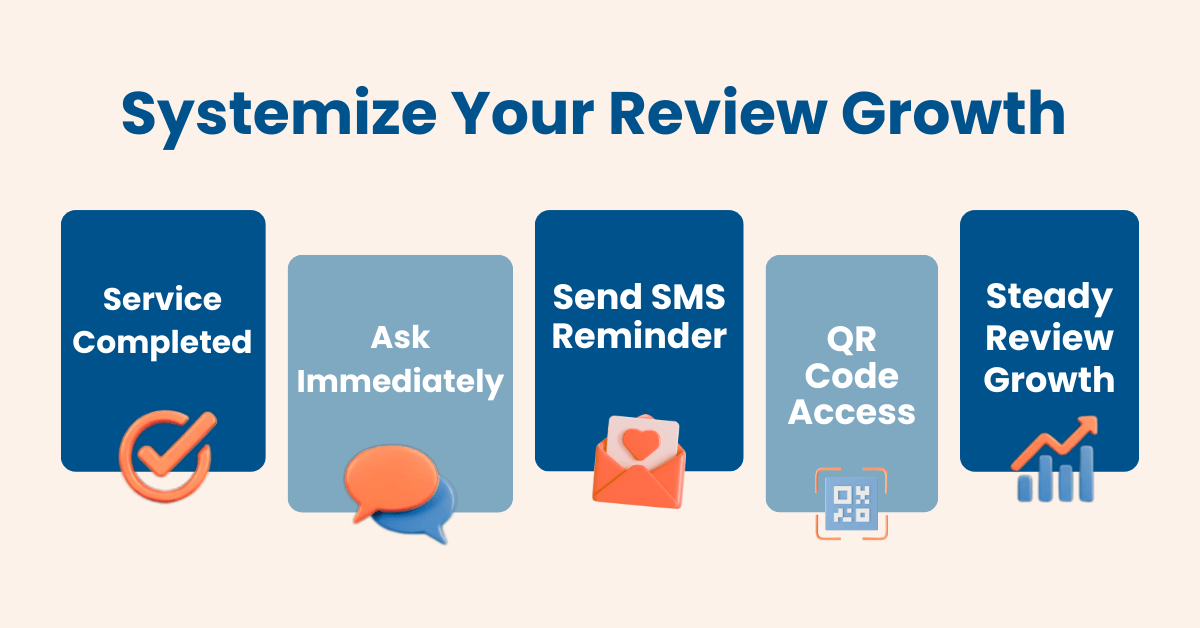
To build a system:
- The Golden Window: Ask for the review immediately after the service is rendered. For a restaurant, that’s before they leave. For a contractor, it’s when the final walkthrough happens.
- Multi Channel Requests: Use a mix of SMS and email. SMS has a significantly higher open rate (often over 90%), making it the most effective nudge.
- In Person Cues: QR codes on business cards or at the checkout counter reduce the friction of searching for your business name.
Optimize Your Google Business Profile for Review Generation
Your Google Business Profile (GBP) is the landing page for your reviews. If it’s messy, customers won’t feel inspired to contribute.
- Direct Review Link: Don’t tell people to go to Google and find us. Use the specific Ask for reviews link found in your GBP dashboard.
- Visual Proof: Encourage customers to upload photos with their reviews. Reviews with images carry more weight in the algorithm and are often pinned to the top of your profile because they provide higher visual evidence of your work.
Master the Art of Review Response
Responding to reviews is one of the few ranking factors you have 100% control over. Data shows that businesses responding to at least 25% of their reviews see a significant lift in both rankings and conversion rates.
When you respond, you aren’t just talking to the reviewer; you are talking to the algorithm and every future customer.
- For Positive Reviews: Don’t just say Thanks. Mention the service. Like, Thanks Sarah, we’re so glad you enjoyed our organic carpet cleaning in Austin. This reinforces your relevance for those keywords.
- For AI Visibility: Tools like ChatGPT and Perplexity crawl these responses to understand your business’s brand voice and reliability.
Diversify Your Review Portfolio Across Multiple Platforms
Google is the king, but it doesn’t live in a vacuum. It cross references data from authoritative third party sites to build your Knowledge Graph.
- Industry Verticals: If you’re a lawyer, Avvo matters. If you’re a contractor, Angi and Houzz matter.
- The Halo Effect: If you have 500 reviews on Google but zero on Yelp or Facebook, Google might view your profile as unbalanced or potentially manipulated. Aim for a 70/30 split between Google and other platforms.
Leverage Review Content for Keyword Optimization
One of the coolest hacks in local SEO is that customers often do your keyword research for you. When a customer writes, “The best gluten free pizza in downtown Chicago,” they are feeding Google exactly what it needs to rank you for those long tail searches.
You cannot tell customers what to write (that’s against Google’s TOS), but you can ask leading questions: “How did you like our pizza today?” This naturally encourages them to use the keywords that matter for your rankings.
Show Customer Reviews on Your Website
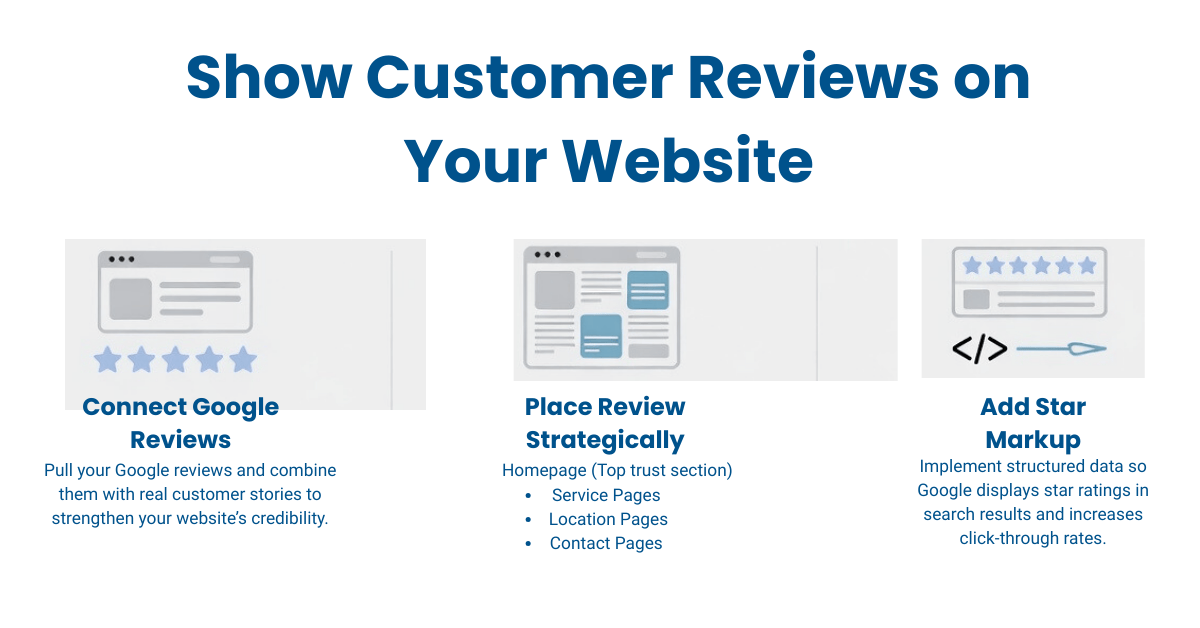
Your website is a great spot to show off customer reviews. Pull in your Google reviews and mix them with real customer stories,this helps search engines link your site to your Google Business Profile.
Put them on your homepage in that trust spot up top, plus service pages, location pages, and contact area. Add star markup so Google displays those ratings right in search results and drives more visitors your way.
Implement Review Schema Markup for Enhanced Visibility
Schema markup is the translator that helps search engine bots read your reviews. By using AggregateRating schema on your website, you can get those coveted gold stars to appear in the organic search results.
While these stars don’t directly move you from position #5 to #1, they dramatically increase your Click-Through Rate (CTR). Since CTR is a known behavioral ranking signal, those extra clicks eventually lead to higher rankings. It’s a virtuous cycle.
Monitor and Manage Your Online Reputation Proactively
You can’t fix what you don’t see. Monitoring means more than just checking your email notifications. You should be looking for trends. Are people complaining about wait times? Are they praising a specific employee? Proactive management involves:
- Sentiment Analysis: Using tools to see if your overall “vibe” is trending up or down.
- Competitor Benchmarking: If your top competitor is getting 10 reviews a month and you’re only getting 2, you are slowly losing the “prominence” battle.
Track and Measure Review Impact on Rankings
To know if this is working, you need to track two things: Map Pack Position and Business Profile Actions (calls, direction requests, website clicks).
Use tools like Google Search Console and GBP Insights. If you see a correlation between a month of high review volume and an increase in Direction Requests, you know your review strategy is directly impacting your bottom line.
Common Review Management Mistakes to Avoid
In 15 years of doing this, I’ve seen these three mistakes kill more rankings than any algorithm update:
- Review Gating: Only sending review links to happy customers. Google has banned this practice, you must ask everyone.
- Slow Responses: Waiting weeks to reply signals that the business is neglected.
- Keyword Stuffing in Responses: Thanks for the Plumbing Austin Repair. It looks robotic and can actually trigger spam filters. Keep it natural.
Conclusion
Local SEO in 2026 is a game of trust. Customer reviews are the currency of that trust. By building a systematic process that prioritizes fresh feedback, keyword-rich content, and active engagement, you aren’t just “gaming” the algorithm, you’re building a resilient digital brand. Google’s job is to reflect the real world; make sure your real-world excellence is reflected in your review profile, and the rankings will follow.
Frequently Asked Questions
How quickly do new reviews affect local rankings?
Fresh reviews influence rankings within days to weeks, as Google prioritizes recency. Businesses adding 5+ reviews monthly often see map pack shifts in 2-4 weeks, based on consistent patterns across updates.
Can I pay customers for reviews?
No, Google penalizes incentivized feedback, dropping rankings or suspending profiles. Focus on genuine requests post-service to build authentic signals.
Should I delete bad reviews?
Never, flag violations only (spam, fake). Respond professionally to dilute impact and show accountability, turning negatives into trust builders.
How often should I check for new reviews?
Daily for small businesses, or set alerts. Quick replies keep sentiment positive and signals fresh.
Is responding to every single review really necessary?
In 2026, Google treats “engagement velocity” as a major ranking signal. Replying to reviews proves your business is active and managed.