
Retargeting campaigns let small businesses re-engage visitors who left without buying. They consistently deliver higher conversion rates, lower ad costs, and better ROI than cold advertising, making them one of the smartest budget moves a small business can make.
Most people who visit your website are not ready to buy on the first visit. Research from Marketo suggests that roughly 96% of first-time visitors leave without taking action. That is a lot of interest walking out the door, and for a small business with a tight marketing budget, every single one of those visitors represents real money spent on traffic that did not convert.
Retargeting fixes that problem. When someone visits your site, a small piece of code called a tracking pixel (available on Google, Meta, and most ad platforms) drops a cookie in their browser. Once they leave, your ads follow them across the web, reminding them about your business until they are ready to come back. It is permission-free, cost-effective, and targets people who already showed interest, making every ad dollar work harder.
How Does Retargeting Work for Small Businesses?
The buyer’s journey is rarely a straight line. A customer might discover you through a Google search, browse a few products, get distracted, and move on. Without retargeting, that person is gone. With retargeting, you get a second (and third) chance to bring them back.
Here is the basic flow:
- A visitor lands on your website or product page.
- The tracking pixel records their visit and behavior.
- They leave without buying.
- Your retargeting ad appears on Google, Facebook, Instagram, or other sites they browse.
- They click the ad, return to your site, and complete the purchase.
The beauty of this for small businesses is that you are not guessing about your audience. These are warm leads, people who already know your brand and showed interest in what you sell.
10 Key Benefits of Running Retargeting Campaigns for Your Small Business
Let us break down each benefit clearly so you can see exactly how retargeting helps your bottom line.
1. Significantly Higher Conversion Rates That Turn Browsers Into Buyers
Retargeted users are already familiar with your brand. They did not stumble on your ad randomly, they visited your site, browsed your offers, and showed clear purchase intent. That familiarity matters. According to WordStream, retargeted website visitors are 70% more likely to convert compared to first-time visitors. When someone sees your ad and already recognizes your brand, the trust barrier is much lower, and that directly improves conversion rates.
2. Increased Brand Recognition and Awareness on a Small Budget
One of the hardest things for small businesses to do is stay visible without spending a lot of money on ads. Retargeting fixes this by always showing your brand to people who already know you. Each impression helps people remember, not by exposing them to something new, but by reminding them of something they already know. This builds trust over time, which turns a casual browser into a loyal customer without costing a lot of money like a big company would.
3. Cost-Effective Advertising That Delivers a Higher ROI
Traditional display ads reach a lot of people. You pay to get in front of thousands of people, most of whom don’t care about your product at all. Retargeting changes this model completely. You’re only targeting people who have already been to your site, which means you’re spending your ad money on the people who are most likely to buy. The result is a much lower cost per acquisition (CPA) and a much higher return on investment, which is very important for small businesses with tight marketing budgets.
4. Reduced Cart Abandonment and Recovered Lost Sales
One of the most annoying problems in e-commerce is when people leave their carts. According to the Baymard Institute, about 70% of people who put things in their cart leave without buying them. That means that 7 out of 10 people who put things in their cart never buy them. Retargeting is like a gentle, well-timed nudge that reminds shoppers of what they left behind and brings many of them back to finish the sale. For a small business, even getting back a small number of abandoned carts can mean a lot of money.
5. Hyper-Personalized Ads That Speak Directly to Your Customer’s Needs
People don’t pay attention to generic ads. People click on ads that are tailored to them. You can easily personalize your ads with retargeting because you already know what a visitor looked at. You can show someone an ad just for running shoes if they spent time on your running shoes page, not your whole catalog. This level of relevance makes the ad seem useful instead of annoying, which leads to much higher click-through and engagement rates. Dynamic retargeting goes even further by automatically putting the exact product that a user looked at into the ad.
6. Higher Click-Through Rates (CTR) Compared to Standard Display Ads
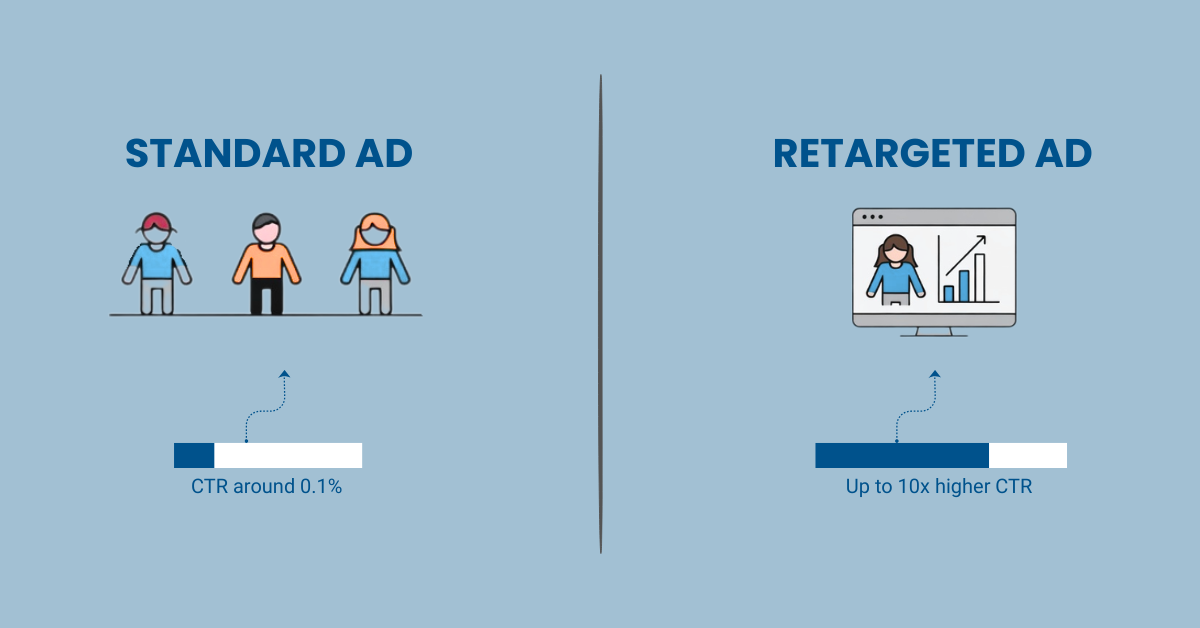
Standard display ads have a bad reputation for having low CTRs, which can be as low as 0.1%. Ads that are retargeted work much better. Criteo’s data shows that retargeted ads can get up to ten times more clicks than regular display ads. The answer is simple: they are relevant and familiar. People are more likely to click on ads that seem relevant to them. A retargeted ad from a brand they already visited is much more relevant than a cold ad from a company they have never heard of.
7. Increased Engagement That Keeps Your Audience Coming Back
Retargeting not only brings people back, but it also keeps them interested throughout the whole consideration phase. Campaigns have been shown to boost overall ad engagement by up to 400% compared to regular campaigns. This means that with each interaction, more people are actively thinking about your brand, looking at your content again, and getting closer to making a decision. It’s hard to get this level of engagement with new visitors, but retargeting makes it possible, even if you don’t have a lot of money.
8. Improved Cross-Selling and Upselling to Grow Customer Lifetime Value
Retargeting isn’t just for getting people who have never been to your site before to buy something. It’s also a great way to get more money from your current customers. You can show people ads for camera bags, lenses, or memory cards again if they bought a camera from your store not too long ago. This way of cross-selling increases the average order value and helps businesses get to know their customers over time. For small businesses that value each customer, this kind of targeted upselling can greatly increase monthly sales without bringing in any new customers.
9. Data-Driven Consumer Insights That Improve Your Entire Marketing Strategy
Every retargeting campaign gives you useful information. You find out which ads get the most clicks, which product pages get the most repeat visits, and which audience segments are most likely to buy. This information is more than just what the retargeting campaign is about. You can use the behavioral data you collect to make your email sequences better, your landing page copy sharper, your social media content more relevant, and your product positioning more accurate. Retargeting analytics is a surprisingly rich source of real customer information for a small business that can’t afford to pay for expensive market research.
10. Enhanced Lead Nurturing That Guides Prospects Down the Sales Funnel
Not every potential customer is ready to buy right away, especially if the product or service costs a lot or takes a long time to decide on. You can stay in touch with them during the whole research period by retargeting. At the beginning, you can show educational content. In the middle, you can show testimonials and social proof. Finally, at the decision stage, you can show ads that focus on offers. This structured nurture approach makes sure that your brand stays relevant at every step. That way, when the prospect is ready to buy, your business is the first one that comes to mind.
Common Retargeting Mistakes Small Businesses Should Avoid
Retargeting works best when it is done thoughtfully. Watch out for these common pitfalls:
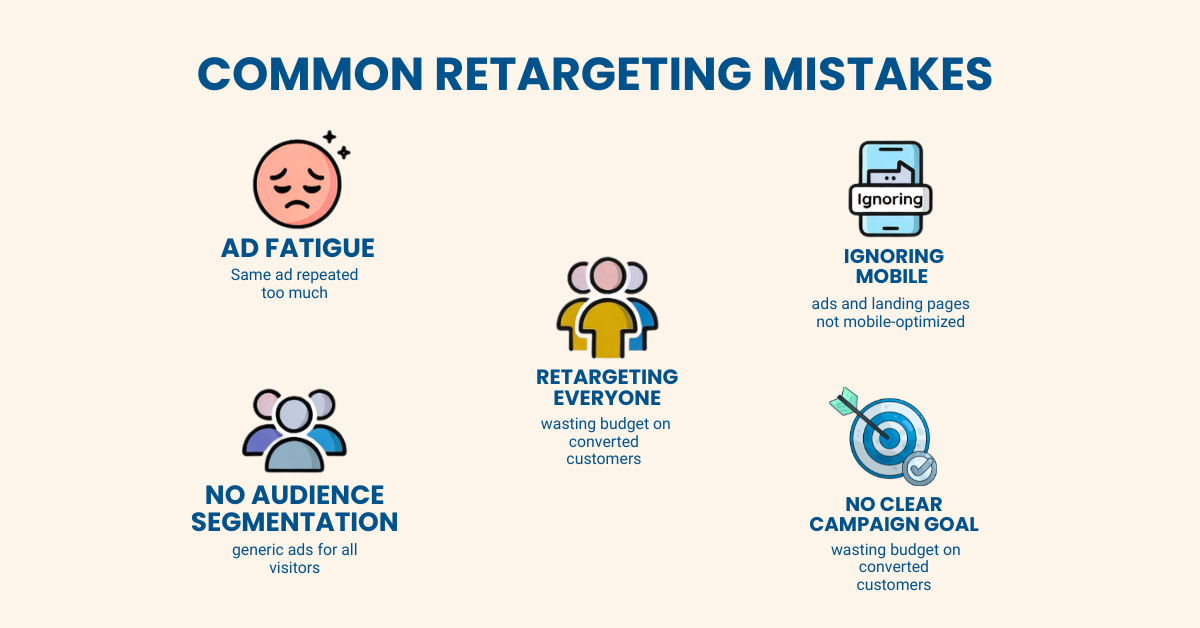
- Ad fatigue: showing the same ad too many times makes people tune it out. Rotate creatives regularly.
- No audience segmentation: treating all visitors the same reduces relevance. Segment by page visited or purchase stage.
- Retargeting everyone: exclude people who already converted so you are not wasting budget on existing customers.
- Ignoring mobile: a large percentage of browsing happens on mobile. Ensure your ads and landing pages are mobile-optimized.
- Running campaigns with no clear goal: always tie your retargeting campaign to a specific objective, whether that is a sale, a sign-up, or a booked call.
Retargeting is one of the few digital advertising strategies where a small business with a modest budget can genuinely compete and win. The logic is sound: you are not interrupting strangers, you are re-engaging people who already showed interest in what you sell. That alone makes every ad dollar go further.
Frequently Asked Questions
What is a retargeting campaign?
A retargeting campaign is a form of online advertising that shows ads to people who previously visited your website but left without taking action. It uses a tracking pixel to follow those visitors across the web and bring them back to complete a purchase or sign-up.
How does retargeting work?
https://www.facebook.com/When someone visits your site, a small piece of code called a pixel drops a cookie in their browser. Once they leave, your ads appear on other platforms they use. like Google, Facebook, or Instagram, reminding them about your business until they return.
Which platforms support retargeting campaigns?
The main platforms are Google Display Network, Meta (Facebook and Instagram), TikTok, LinkedIn, and Pinterest. Google and Meta are the most widely used by small businesses due to their large reach and easy pixel setup.
Why are my retargeting ads not converting?
Common reasons include no audience segmentation, ad fatigue from showing the same creative too often, targeting people who have already purchased, or mismatched ad messaging. Segment your audience by behavior, rotate creatives regularly, and always exclude existing customers.
What is the average CTR for retargeting ads?
Retargeting ads usually get 10 times more clicks than regular display ads, which get less than 0.1% of clicks. The exact CTR depends on the industry, platform, and quality of the creative, but retargeted audiences always do better than cold audiences.