
Want your content to show up in AI search? Focus on three things: write clear, well-structured content that answers questions directly, prove you actually know what you’re talking about through real expertise, and get the technical stuff right, schema markup, fast loading, clean code. AI tools care more about giving accurate answers than counting keywords.
Search isn’t what it used to be. Sure, Google still handles billions of searches daily, but something’s shifted. People are turning to ChatGPT, Perplexity, and even Google’s own AI Overviews instead of scrolling through ten blue links. Gartner predicts traditional search volume will drop 25% by 2026, and honestly? That tracks with what we’re seeing.
Here’s what makes this tricky: AI doesn’t just rank your page anymore. It reads your content, pulls out the good stuff, and uses it to answer someone’s question—sometimes without them ever visiting your site. That old-school approach of jamming keywords everywhere and chasing backlinks? Still helps a bit, but it’s not the whole game anymore.
AI wants clarity. It wants structure. Most of all, it wants content written by people who actually know their stuff, not content farms churning out generic fluff.
What are the best SEO practices for AI-generated search results?
AI search tools judge your content differently than traditional crawlers. They’re looking for signals that your content deserves to be quoted and shared.
E-E-A-T still runs the show: Experience, Expertise, Authoritativeness, Trustworthiness, these aren’t just buzzwords anymore. AI models get trained on quality content, so they naturally gravitate toward these signals. Put your author bio front and center. Link to solid sources. Keep your content fresh because outdated info screams “don’t trust this.”
Your site’s technical foundation matters way more now: AI crawlers need easy access to your stuff. Clean site structure with logical internal links helps AI understand how your topics connect. Page speed isn’t optional either, Cloudflare’s data shows sites loading under 2 seconds get indexed three times faster than slow ones. That’s huge.
Here’s something most people miss: check your robots.txt file. Many sites accidentally block AI crawlers like GPTBot, Claude-Web, and PerplexityBot without realizing it. Open that file and make sure you’re allowing legitimate AI bots while keeping out the sketchy scrapers.
Mobile optimization is mandatory: Over 60% of searches happen on phones now. Google indexes the mobile version of your site first, which means if your mobile experience is trash, you’re invisible. AI search engines follow the same logic.
How does AI search differ from traditional Google SEO?
Traditional Google SEO is all about climbing the rankings. You fight for position one, get clicks, track traffic. AI search plays a completely different game.
AI synthesizes answers instead of listing links: When someone asks ChatGPT or Perplexity something, they don’t get ten options to click. The AI reads multiple sources, grabs the relevant facts, and writes an answer on the spot. Your content becomes raw material. Getting cited matters more than ranking first, because there is no “first” anymore.
People talk to AI like it’s a person: Nobody types “coffee stain removal tips” into ChatGPT. They ask “what’s the best way to get coffee stains out of my white shirt?” SEMrush found that question-based queries jumped 61% year-over-year. Voice search and AI chat are changing how people look for information.
Real-time synthesis changes everything: Google caches results. AI can pull from sources published yesterday or this morning, mixing fresh info with established knowledge. Suddenly, keeping content updated matters as much as writing good content in the first place.
The old ranking factors, domain authority, backlinks, exact-match domains, still influence which sources AI trusts. But now clarity and directness compete head-to-head with authority. A crystal-clear answer from a newer site might beat a vague response from an industry giant.
What keywords work best for AI overviews and summaries?
Forget chasing high-volume keywords. AI search needs a different approach focused on what people actually want to know.
Focusing on long tail, question based keywords is key: “How do I optimize my content for AI search engines” will crush a standard keyword like “AI SEO”. Why? AI models trained to answer certain questions According to an Ahrefs study, long-tail keywords containing 4 or more words receive a CTR 3-5 times higher in AI-generated responses.
The intent behind a keyword is more important than the volume behind it: The keyword “what schema markup helps AI search visibility” which has under 100 searches, is better than the generic keywords which get thousands of searches every month “SEO tips”. Precision Triumphs.
Natural language patterns are critical: Your keywords should sound like actual human speech. “Why isn’t my content showing in AI search” works way better than “AI search content not indexed causes.” AI models trained on real conversations can spot unnatural phrasing instantly.
Target the question words: what, how, why, when, where, which. Build your content around answering these questions. Each section should tackle a specific query variation of your main topic.
How to structure content for AI crawlers and indexing?
Content structure determines whether AI can actually use your information. Poor structure means your expertise gets ignored no matter how good it is.
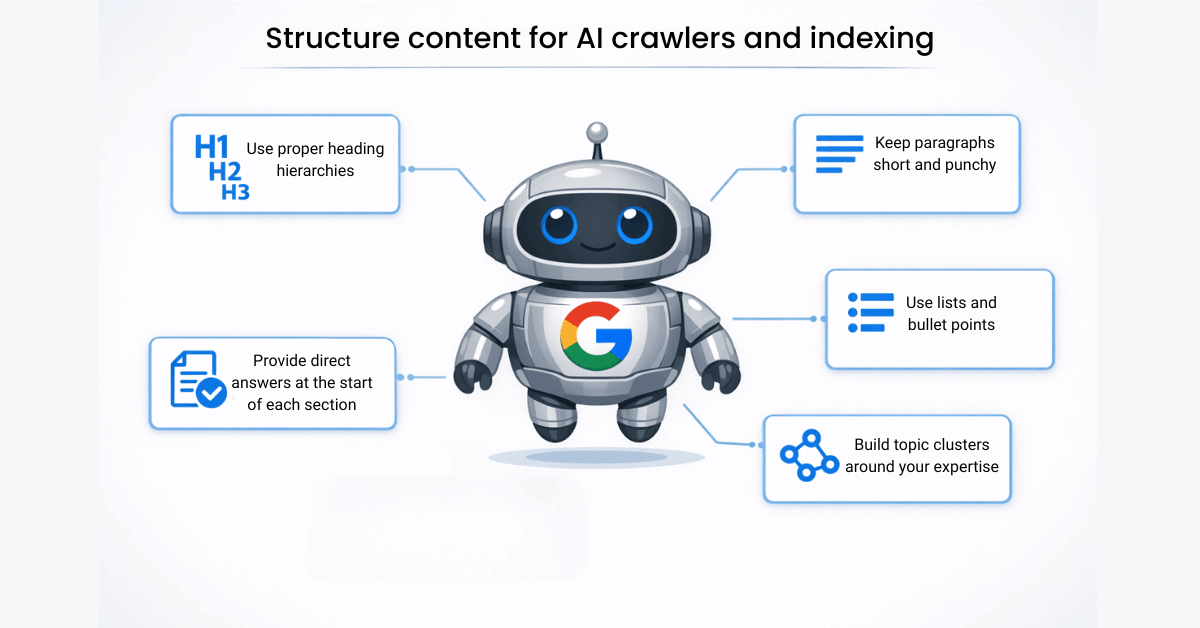
Use proper heading hierarchies: H1 for your title, H2 for main sections, H3 for subsections. This logical flow helps AI understand how your topics organize. Never skip levels, jumping from H2 to H4 confuses the parsing.
Keep paragraphs short and punchy: AI processes information in chunks. Two-to-four sentence paragraphs work better than walls of text. Plus, humans find it easier to read too.
Lists and bullets are your friends: When you format information as bullets or numbered steps, AI can grab and cite specific points easily. Backlink‘s research found content with lists gets featured in AI summaries 2.3 times more often than pure paragraphs.
Build topic clusters around your expertise: Create a main pillar page covering your topic broadly, then link out to detailed pages on specific subtopics. This structure screams “we know this subject inside and out” to AI crawlers. Internal linking between related content helps AI map your knowledge base.
Answer the question right away. Put clear, direct answers at the start of each section. AI scans for immediate responses to queries. You can expand and explain after, but lead with the answer.
Tips for writing AI-friendly content that ranks in generative search
Writing for AI doesn’t mean writing like a robot. It means writing exceptionally clear content that helps human readers while making extraction easy for algorithms.
Get to the point fast: Cut the fluff. AI favors content that answers questions without dancing around. If you can explain something in 50 words instead of 200, do it. Respect your reader’s time.
Write like you’re talking to a smart friend: Natural, conversational language works best. Skip the jargon unless your audience expects technical terms. AI models trained on natural language respond better to conversational tone because that’s what they learned from.
Bullet points for anything important: Lists, steps, key takeaways, use bullets. This formatting signals “pay attention to this” for both AI and humans.
Answer first, explain later: Start each section with a straightforward answer to the question in your heading, then dive into details. This pattern matches how AI extracts information naturally.
Back up your claims with sources: When you mention statistics or studies, say where they’re from. AI tracks citation quality. Facts with attribution carry way more weight than random claims pulled from thin air.
Keep content current: Fresh information signals reliability. Add publication dates and “last updated” stamps. AI search prioritizes recent info, especially for topics that change over time.
How to use schema markup for better AI search visibility?
Schema markup is structured data that tells AI exactly what your content contains. Think of it as adding labels machines can instantly read.
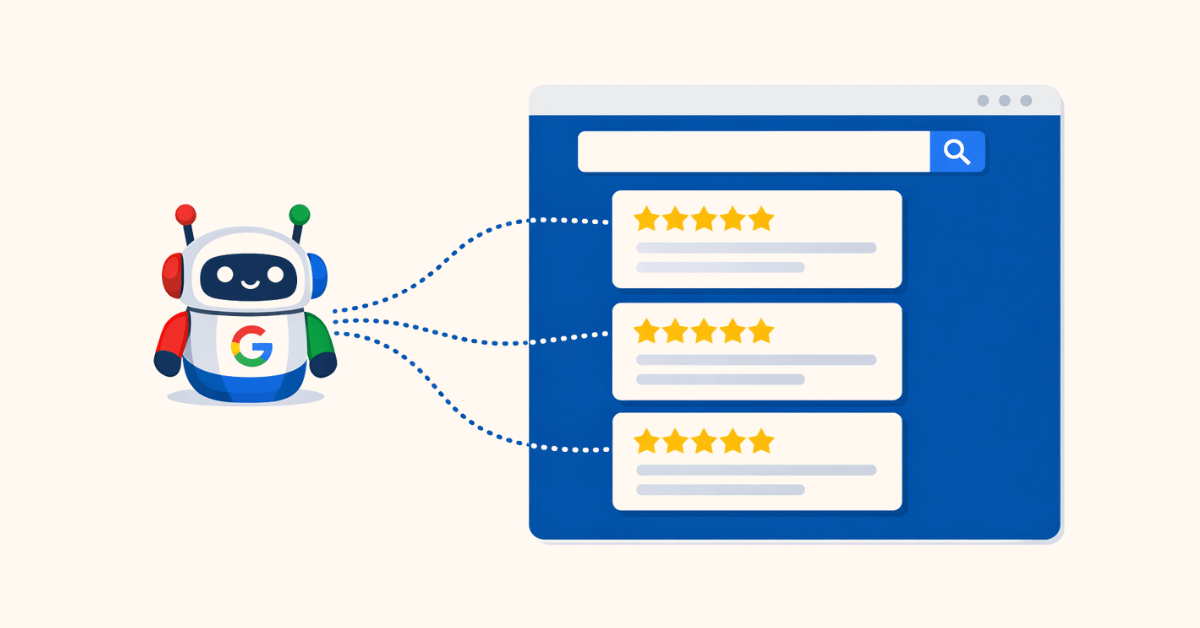
JSON-LD is the way to go: This schema format lives in your page header and doesn’t mess with your visible content. Google, Bing, and AI crawlers all recognize JSON-LD as standard.
Article schema helps AI understand your content type: Mark up blog posts with Article schema including headline, author, publish date, and modified date. This tells AI what kind of content it’s looking at and how fresh it is.
FAQ schema feeds directly into AI answers: Got frequently asked questions in your content? Use FAQPage schema. AI models pull straight from structured FAQ data when generating responses. Search Engine Land found pages with FAQ schema get featured in AI overviews 40% more often. That’s not a small difference.
How To schema for step-by-step guides: Instructional content benefits big-time from How To schema. This markup labels each step explicitly, making it dead simple for AI to extract and present your instructions.
Test your schema before going live: Use Google’s Structured Data Testing Tool to validate everything. Broken or incorrect markup just gets ignored by crawlers, so you might as well not have it. The tool catches errors and suggests fixes.
What content formats perform well in AI search responses?
AI search tools prefer certain formats because they’re easier to parse and present to users.
Lists and step-by-step guides crush it: Numbered steps or bulleted lists show up in AI summaries way more than paragraph-only content. The structure makes extraction straightforward—AI doesn’t have to work to find the information.
Comparison tables work beautifully: When you present info in tables comparing products, features, or options, AI can grab specific data points instantly. Tables also make scanning easy for human readers, so it’s a win-win.
Comprehensive guides signal authority: Long-form content over 1,500 words that thoroughly covers a topic tells AI you’re serious. HubSpot research showed comprehensive guides get cited in AI responses 67% more than short articles. Depth matters.
Video paired with transcripts: Video content alone is hard for AI to process. Add an accurate transcript and suddenly AI has multiple ways to understand your information. The transcript makes the video searchable and extractable.
FAQ sections are AI gold: Dedicated FAQ pages or sections perform incredibly well because they match the exact question-answer format AI uses. Structure FAQs with clear questions as headings and tight answers below.
Common mistakes to avoid when optimizing for AI search
Even smart marketers make these mistakes that tank AI search visibility.
Keyword stuffing ruins everything: Repeating the same phrase over and over sounds robotic to language models trained on human writing. AI flags this as low-quality instantly. Write naturally and keywords appear where they should.
Slow mobile sites kill your chances: Sluggish mobile performance frustrates users and bogs down crawlers. Google’s data shows pages loading over 3 seconds lose 53% of mobile visitors. AI crawlers prioritize fast, accessible content because that’s what serves users best.
Thin content offers nothing worth citing: Pages under 300 words rarely contain enough substance for AI to reference meaningfully. Shallow content that doesn’t fully answer questions loses to comprehensive alternatives every time.
Accidentally blocking AI crawlers is surprisingly common: Many standard robots.txt configurations block newer AI user agents by default. Check your file and explicitly allow GPTBot, Claude-Web, and other legitimate AI crawlers. Otherwise your content is invisible to these platforms.
Skipping schema implementation is leaving money on the table: No structured data means AI works harder to understand your content. Why handicap yourself? Proper schema gives you an edge over competitors who ignore it.
How to measure and track AI search performance for my content?
Traditional analytics don’t capture AI search impact because users might never click through to your site.
Google Search Console now tracks AI Overviews: The platform added metrics showing when your content appears in AI-generated summaries. Check the “Search Results” report and filter for AI Overview impressions to see your visibility.
Watch referral traffic from AI platforms: Set up UTM parameters or check referral sources for traffic from ChatGPT, Perplexity, and other AI tools. This direct measurement shows when AI cites your content with actual links.
Monitor branded search increases: If AI mentions your brand without linking, users often search for you directly afterward. Rising branded search volume can indicate AI visibility even without direct clicks showing up in your analytics.
Try third-party AI search tracking tools: Platforms like BrightEdge and Semrush now offer AI search visibility scores. These tools monitor how often your content gets cited across various AI platforms, giving you a clearer picture.
Check “People Also Ask” performance: Google’s PAA boxes often pull similar content to what AI Overviews use. Strong PAA visibility usually correlates with AI search success because both favor the same type of clear, authoritative answers.
Conclusion
Structure, facts, and authority are what make content rank in AI search. The winning approach: answer questions directly, use proper heading hierarchy, implement schema markup, and prove expertise through cited information.
Don’t resist AI, provide it with quality data. Create content for people first, while keeping AI parsing straightforward with a clear structure. Brands that focus on being truly helpful rather than gaming the algorithms are succeeding.
It is not optimised for tricks that best ensure visibility but rather it is the best source. While challenging, it is more sustainable in the long run.
Frequently Asked Questions
Will AI replace traditional SEO?
No, but it changes it. SEO is shifting to GEO (Generative Engine Optimization). You will focus less on keywords and more on being a trusted source of data.
How do I get ChatGPT to cite my website?
To get cited, you must publish unique statistics, original research, or expert opinions. Also, ensure your brand is mentioned on other authoritative websites.
Does content length matter for AI search?
Not as much as before. AI prefers concise, direct answers. A short, accurate article often performs better than a long, fluffy one in AI results.
Is structured data necessary for AI optimization?
Yes. Structured data (Schema) is one of the best ways to speak the same language as the AI, making it easier for it to index your facts.
Can I use AI to write my content and still rank?
You can use AI for outlines and ideas, but the final content should be written by a human. Search engines prioritize “Experience” (E-E-A-T), which AI cannot replicate.